


Shore power
at all terminals
at the PORT OF KIEL
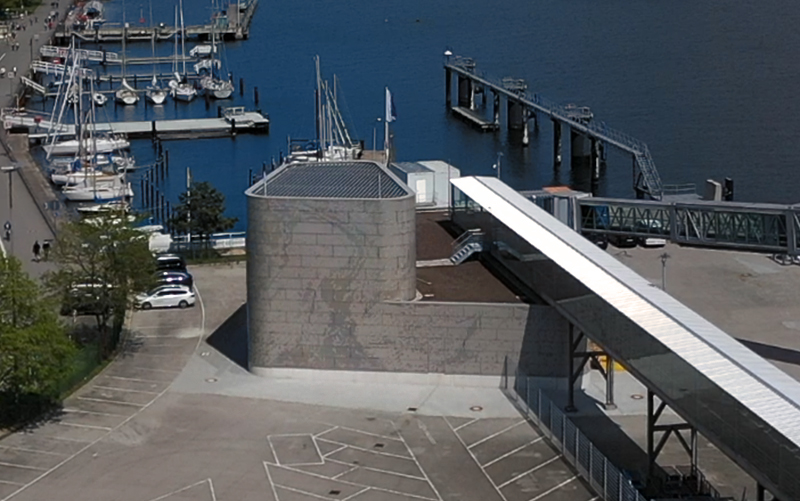
The expansion of our shore power infrastructure is a key component of our BLUE PORT strategy. Shore power enables us to significantly reduce CO₂, air pollutant and noise emissions from ferries and cruise ships whilst they are berthed in the PORT OF KIEL. With the commissioning of a further shore power facility at the Ostseekai in 2025, we will have successfully completed the expansion of our shore power infrastructure. This will enable us to supply up to seven vessels simultaneously with shore power at our terminals – three cruise ships and up to four ferries.
Overview shore power terminals
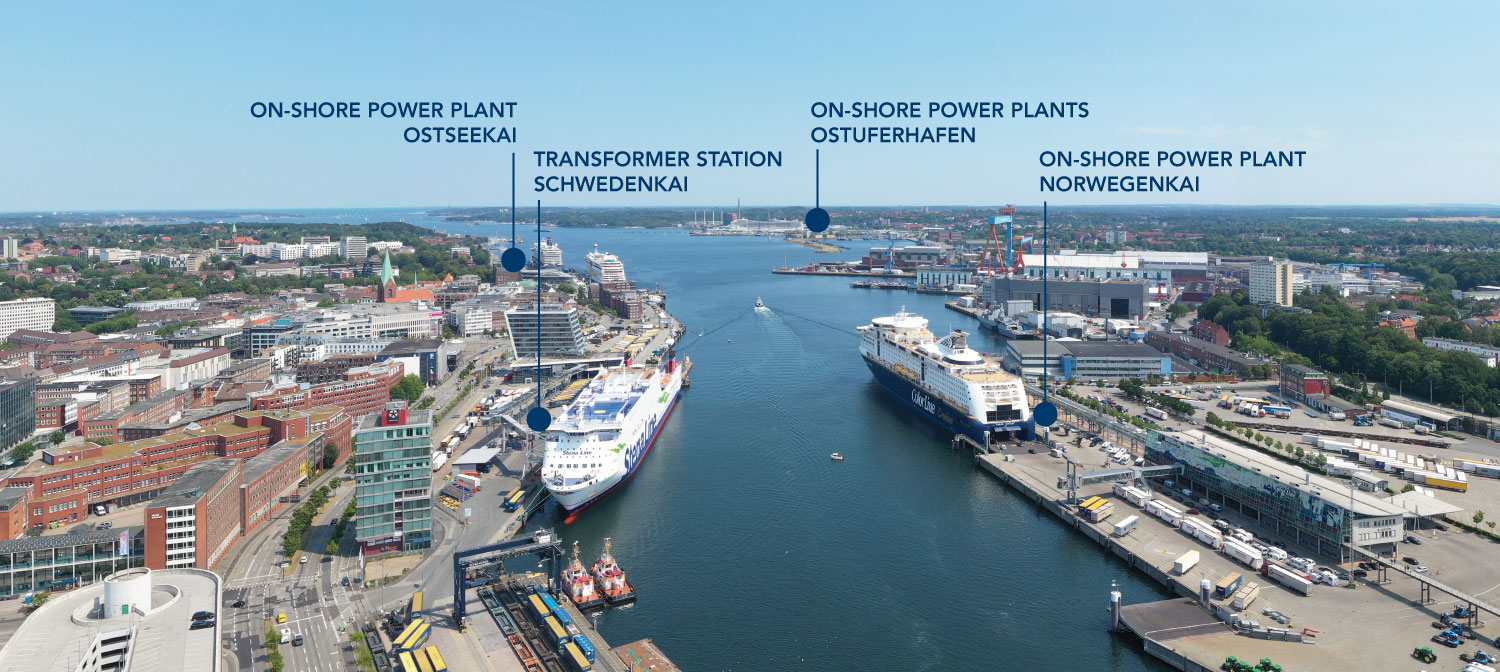
| Our terminals | Ostseekai | Schwedenkai | Ostuferhafen | Norwegenkai |
|---|---|---|---|---|
| Opening shore power | 2021/expansion 2025 | 2021 | 2023 | 2019 |
| Shore power berths | 2 | 1 | 4 | 1 |
| Performance | 2 x 16 MVA 50/60 Hz 6,6/11 kV |
5 MVA 50/60 Hz 6,6/11 kV |
16 / 4,5 MVA 50/60 Hz 6,6/11 kV |
4,5 MVA 50 Hz 10 kV |
| Type of ship | Cruise | Ferry | Cruise & ferry | Ferry |
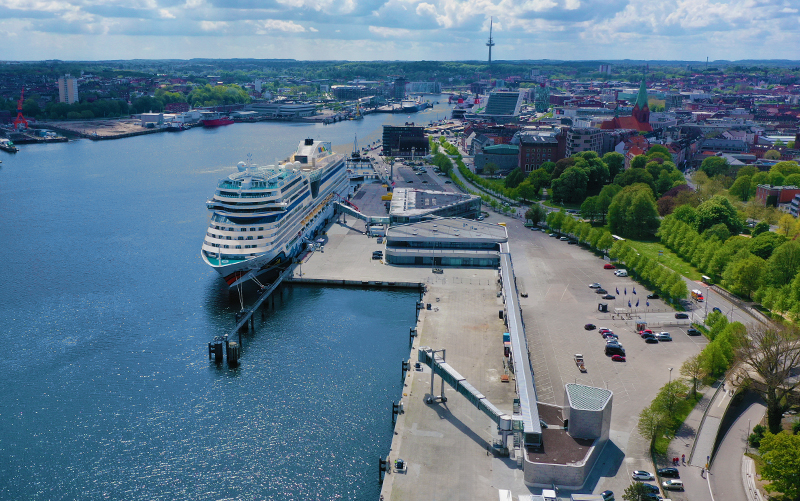
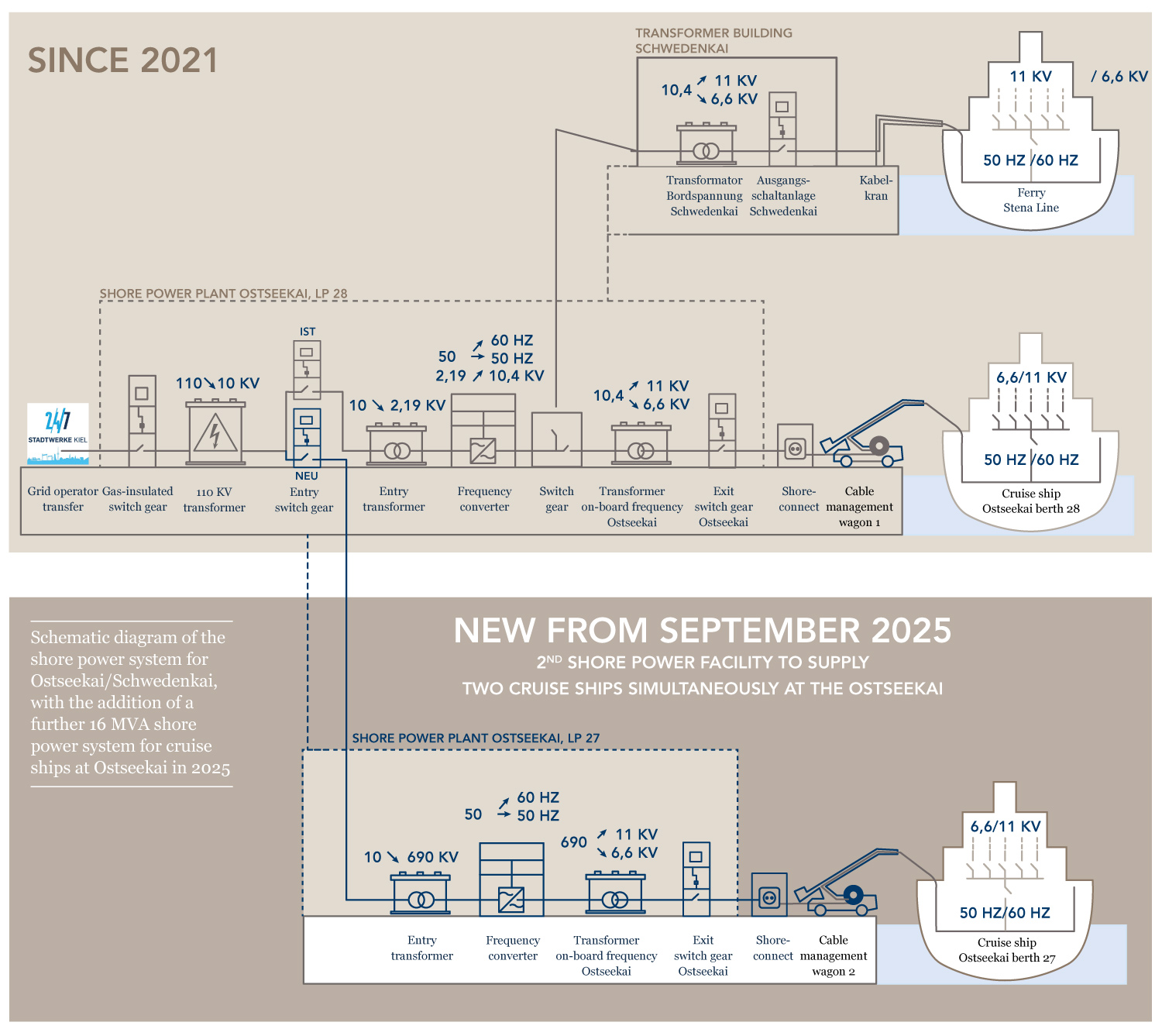
Since autumn 2025, the second shore power facility at the Ostseekai has enabled two cruise ships to be supplied simultaneously. The new facility supplies berth 27, whilst the existing facility, built in 2021, continues to supply cruise ships at berth 28 and ferries at berth 24a. With the completion of this expansion, we have been meeting the requirements of the European AFIR Regulation on the provision of shore power for passenger ships of more than 5,000 GT since 2025 – five years ahead of the relevant implementation date of 2030.
Our shore power systems were funded by ...
FAQ - Frequently asked questions about “Shore power”
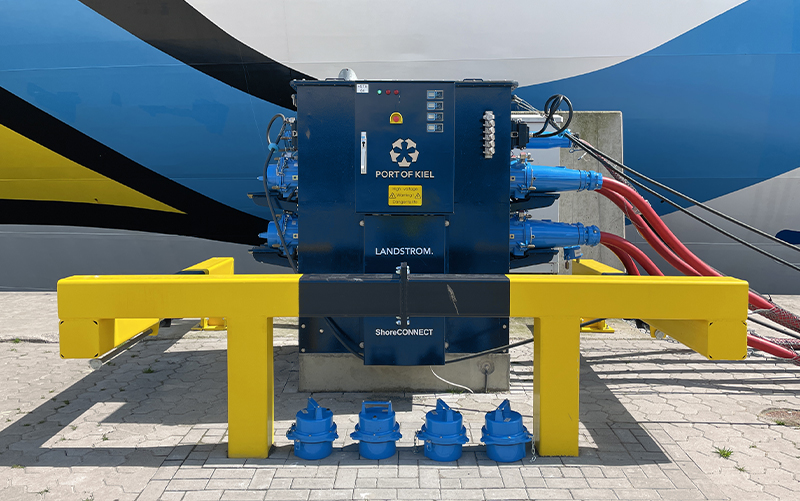
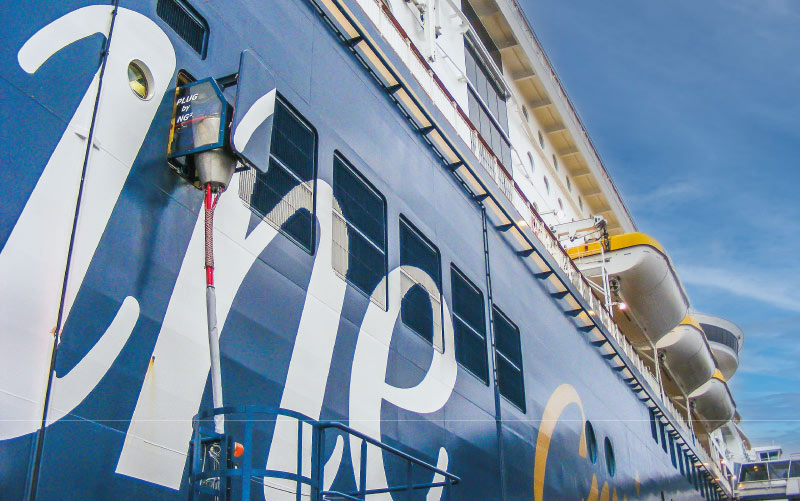
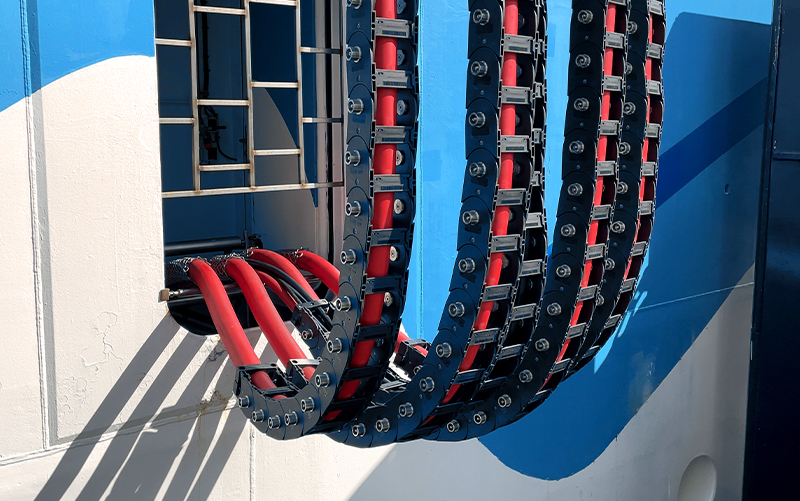
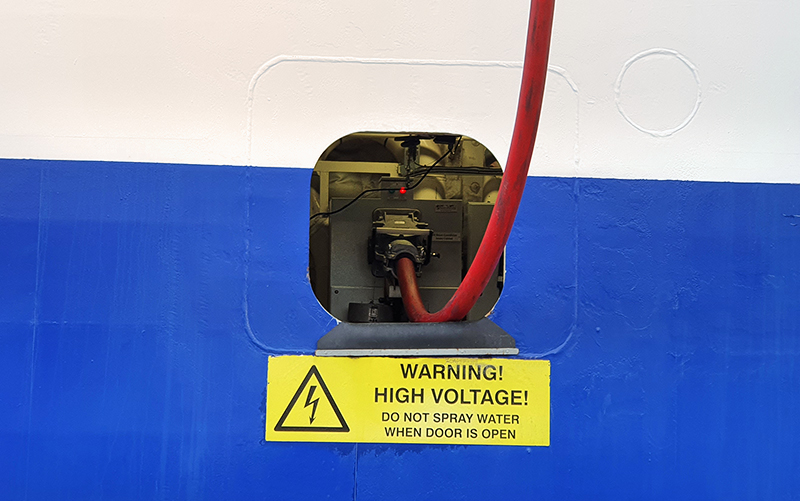
The term ‘shore power’ refers to the supply of electricity to a ship’s on-board electrical system from the onshore grid whilst the vessel is berthed in port. Mooring, plugging in, switching off the generators. This procedure has now become part of everyday life in the port of Kiel. Ships operated by international shipping companies have different technical standards and varying requirements for their power supply. In our shore power systems, we adjust the voltages (6.6/11 kilovolts) and frequencies (50/60 hertz) to meet the specific requirements of each vessel. This allows the ships’ on-board generators to be switched off whilst the vessels are berthed.
To operate our shore power systems, we purchase electricity on the spot market as and when required. We document the renewable origin of these electricity volumes by acquiring guarantees of origin. Since 2014, we have also been sourcing green electricity with corresponding guarantees of origin to power our properties and electrical handling equipment. In addition, we generate our own solar power on our port premises.
Even whilst berthed, ferries and cruise ships require electrical power, for example for lighting, air conditioning and the operation of technical systems. Our shore power systems make it possible to meet this electricity demand via the onshore grid. This allows the on-board diesel generators used to generate electricity to be switched off, thereby significantly reducing the associated CO₂, air pollutant and noise emissions whilst the vessels are berthed. The shore power supply is provided by high-performance systems that adapt the electricity from the public grid to the technical requirements of the respective vessels. This includes, in particular, the required voltage and frequency.
Shore power supply at Ostseekai and Schwedenkai
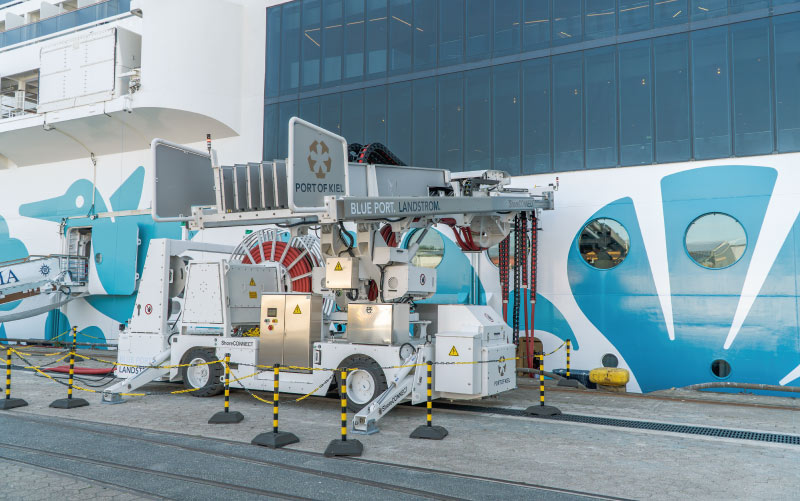
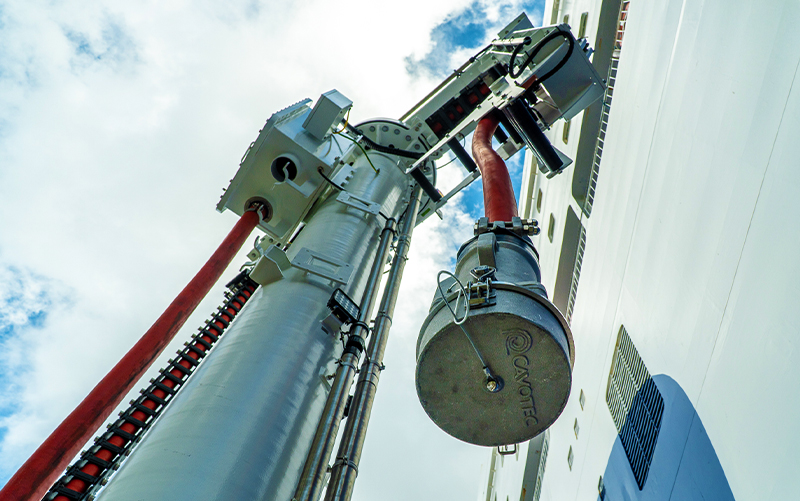
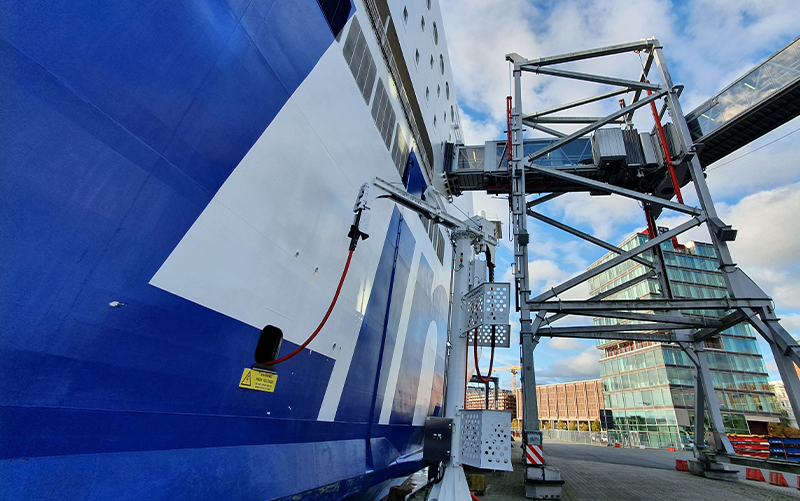
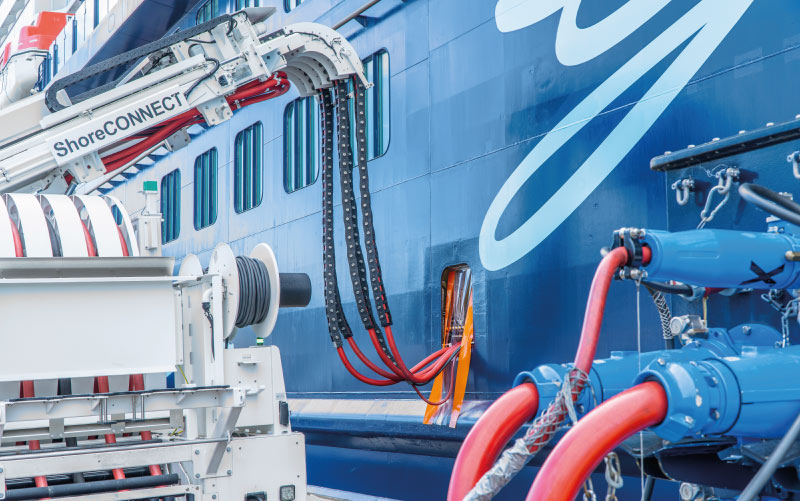
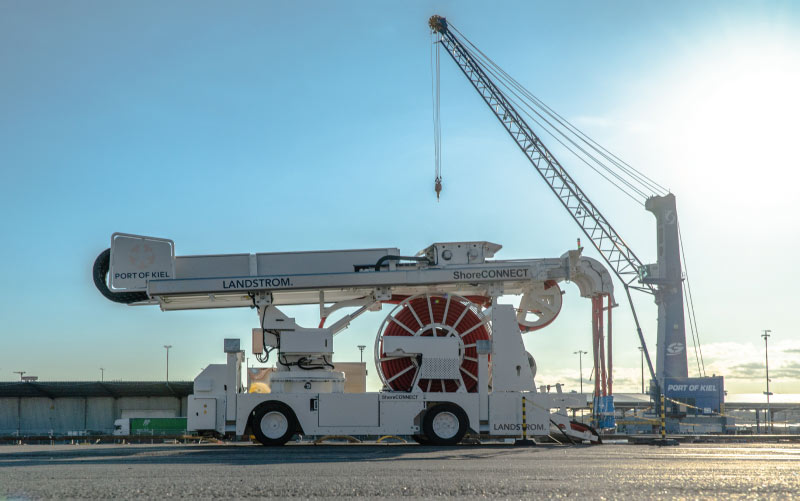
The shore power facility, which came into operation in 2021, supplies ferries at Schwedenkai and cruise ships at Ostseekai, berth 28. Transformers and frequency converters are used to adapt the electricity to the respective requirements of the ships. Power is transferred via a cable crane at Schwedenkai and via a cable connection vehicle at Ostseekai. In September 2025, the infrastructure at Ostseekai was expanded to include a further shore power facility with a capacity of 16 MVA. The new facility supplies cruise ships at berth 27, whilst the existing facility continues to supply power at berth 28 and ferry berth 24a.
This means that, for the first time, two cruise ships can be supplied with shore power simultaneously at Ostseekai.
Yes. Since 2025, all major ferry and cruise terminals at the PORT OF KIEL have been equipped with shore power connections.
Norwegenkai was the first to be equipped in 2019. This was followed in 2021 by the combined shore power facility at Ostseekai and Schwedenkai. With the commissioning of two shore power facilities at Ostuferhafen in 2023, the supply was extended to the largest part of the port of Kiel. In autumn 2025, we completed the expansion of our shore power infrastructure with the commissioning of a further shore power facility at Ostseekai. Since then, two cruise ships have been able to be supplied simultaneously there. In total, our terminals have the capacity to supply shore power to up to seven ships simultaneously. This means that we have been complying with the requirements of the European AFIR Regulation on the provision of shore power for passenger ships of more than 5,000 GT since 2025 – five years ahead of the relevant implementation date of 2030.
The port-wide shore power supply for ferries and cruise ships is a key element of our BLUE PORT strategy. Shore power alone is not the solution, but it makes an important contribution to reducing emissions whilst vessels are berthed in port. In 2025, 58 per cent of all ferry and cruise ship calls at the port of Kiel used shore power. This prevented the emission of approximately 8,157 tonnes of CO₂ as well as other air pollutants. With the completion of the expansion of our shore power infrastructure, we have created the technical conditions to further increase the use of shore power in the coming years. It is also crucial that the ships calling at the port are suitably equipped.
At sea, too, the shipping industry is undergoing change. Alternative fuels, hybrid propulsion systems and new technologies are set to help reduce emissions whilst at sea in future. LNG (Liquefied Natural Gas) is one of the key factors in this. We established the legal framework for bunkering in collaboration with Lloyd’s Register as early as 2022. In 2023, a cruise ship was supplied with liquefied natural gas in a German port for the first time, in Kiel. Since then, ships have been regularly bunkering LNG in the port of Kiel. Looking ahead, alternative energy sources such as bio-LNG are also set to gain in importance. As the PORT OF KIEL, we are supporting these developments and creating the infrastructural conditions for their future use.
Read more about Ship drives of the future ...
No. Even as alternative fuels and propulsion technologies continue to develop in the shipping industry, we believe that shore power will play an important role in the long term. Whilst alternative propulsion systems are primarily designed to reduce emissions at sea, shore power enables ships to be supplied with electricity whilst in port without the need to operate their on-board generators. In the future, the shore-side electricity infrastructure could also be used to charge battery storage systems on board ships. By expanding our shore power facilities, we have laid the necessary technical foundations for this.
We have reached an important milestone with the expansion of our shore power infrastructure. However, actual usage also depends on the technical specifications of the vessels calling at the port and the operational conditions. In 2025, the shore power connection rate stood at 58 per cent overall. The several-month outage of the shore power facility at Ostseekai, due to necessary refurbishment and expansion work, had an impact on the connection rate. Based on trends to date, we anticipate a connection rate of around 75 per cent for 2026. The final figures will only be available after the end of the reporting year.
Further information on the development of our shore power strategy, the milestones achieved and our climate targets can be found in our PORT REPORT 2026.